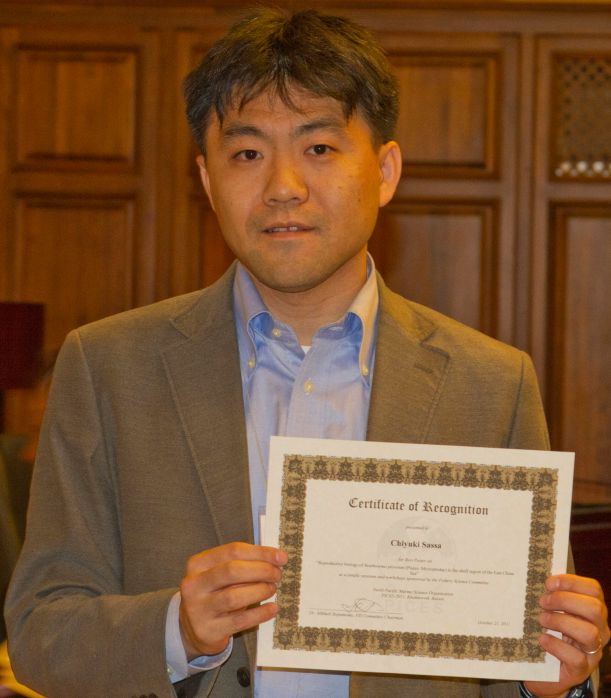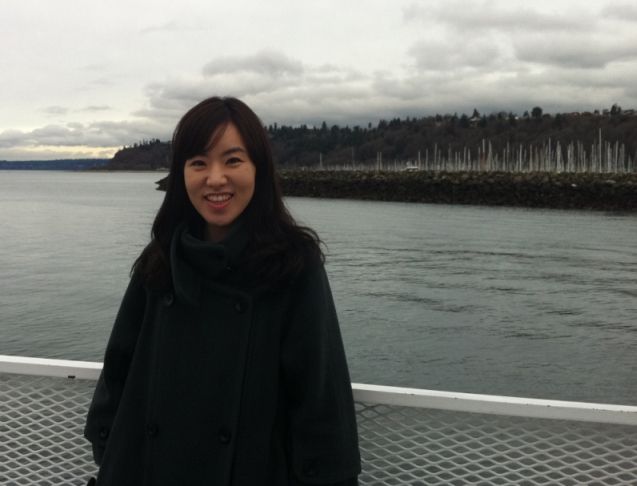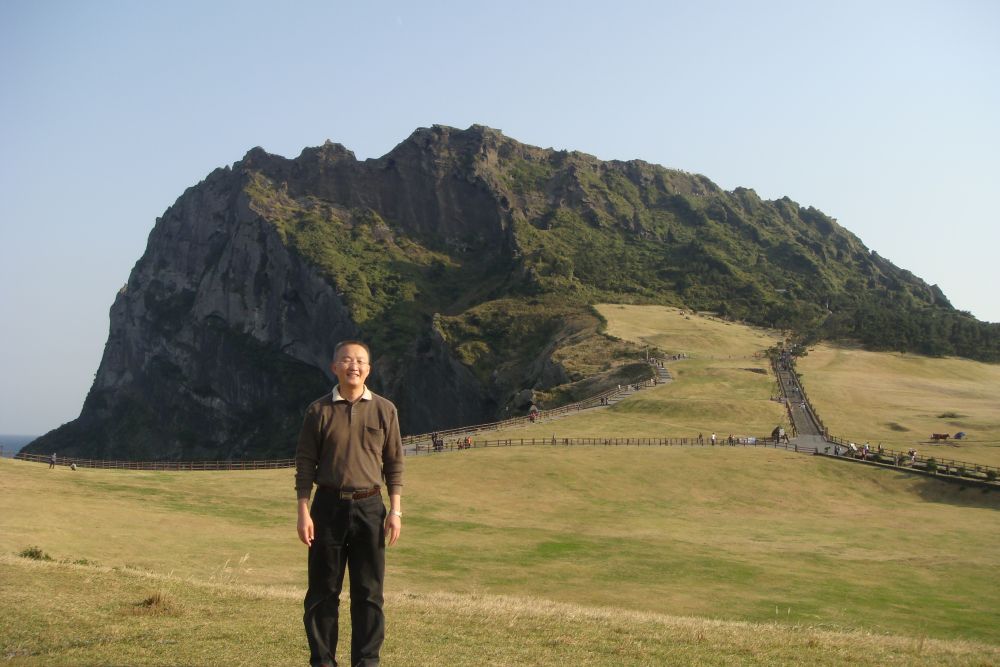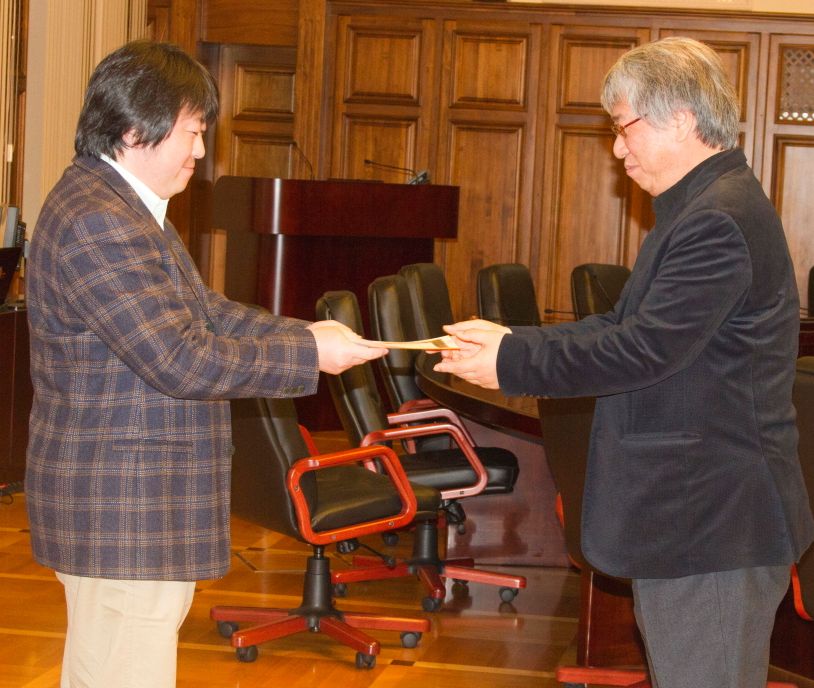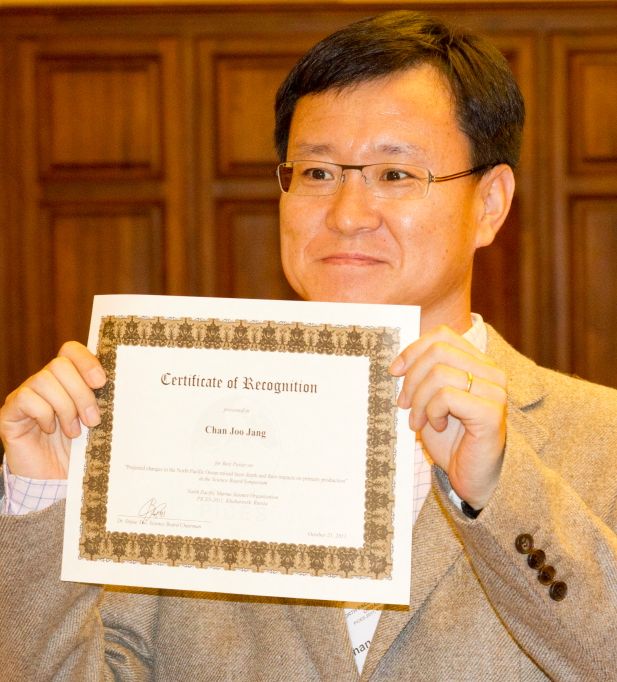
Sukgeun Jung is a faculty member majoring in
fisheries science at Jeju National University,
Korea. Sukgeun received B.Sc. from Seoul National
University (oceanography) in 1987, M.S. from National
Fisheries University of Pusan (now Pukyong National
Unviersity) in 1989, and Ph.D. from University
of Maryland, College Park with emphasis in fish
ecology and fisheries science in 2002. He worked
at Chesapeake Biological laboratory of University
of Maryland Center for Environmental Sciences
for his PostDoc under Professor Edward D. Houde
from 2002 to 2006. After returning to Korea in
2006, he worked as a fisheries researcher at National
Fisheries R&D institute (2006-2010). His study
areas include fisheries oceanography (climate
change), stock assessment/management, fish ecology
(anchovy and Pacific cod), mathematical biology,
and biostatistics. He worked for the secretariat
of Korea PICES committee (2008-2010).Currently,
he is a lead author for the Chapter 30 (“Open
Oceans”) of the 5-th Assessment Report (AR5)
of the IPCC (2010-2014), and a member of PICES
FIS committee (2009-present).
Maurice Levasseur is a professor in oceanography
at Laval University, Quebec, Canada. He worked
as a researcher and head of the Primary Productivity
Section for the Department of Fisheries and Oceans
before moving to Laval University to hold the
Canada Research Chair on Plankton-Climate interactions.
He is director of Quebec-Ocean, a network regrouping
marine scientists and students from four institutions
in the province of Quebec, and is director of
the joint UQAR-U Laval PhD program in oceanography.
Maurice’s main interest focuses on the interactions
between the oceans and the atmosphere, including
the impact of dust and ash deposition on plankton
ecosystems and their capacity to produce the climate
active gas dimethylsulfide (DMS). He has worked
in different environments, including the North
Atlantic, North Pacific and Arctic oceans. During
recent years, he has lead the Canadian SOLAS program
(2002-2007), the Arctic SOLAS program (2008-2011),
and the joint Québec-China research program
on the impact of Asian dust on the Northeast Subarctic
Pacific.
William
Sydeman Farallon
Institute for Advanced Ecosystem Research, U.S.A.
Dr. William J. Sydeman is a veteran marine ecologist
with 30 years of experience studying the California
Current and other North Pacific marine ecosystems.
As President and Senior Scientist with the Farallon
Institute for Advanced Ecosystem Research in northern
California, Sydeman currently manages a non-profit
scientific organization dedicated to the understanding
and preservation of healthy marine ecosystems,
as well as conducts original research designed
to provide the scientific basis for ecosystem
management practices and policy reforms consistent
with a productive marine world. Sydeman’s
specialities include investigations of natural
and human-based climate change and the broad implications
and influences of ocean currents, weather patterns,
fishing practices and coastal development on marine
food webs and ecosystem processes. Originally
cross-trained in oceanography, quantitative population
biology, and ecology at University of California,
Sydeman now works on physical-biological interactions
on a variety of taxa from seabirds and marine
mammals to krill and forage fish. From 2003 to
2010, Sydeman served the PICES community as co-chair
of the Advisory Panel for Marine Birds and Mammals.
Dr. Mitsuo Uematsu was born in Osaka, Japan.
He received his PhD in Geochemistry from Hokkaido
University, Japan in 1980. He then worked on the
Sea/Air Exchange (SEAREX) Program at the Center
for Atmospheric Chemistry at the Graduate School
of Oceanography (GSO), the University of Rhode
Island (URI) as a Research Associate from 1980
to 1987. He then joined the new Department of
Marine Science and Technology at Hokkaido Tokai
University until 1997. He is currently a Professor
and the Director of the Center for International
Collaboration, Atmosphere and Ocean Research Institute,
at the University of Tokyo. His major research
interests include the long-range transport of
natural and anthropogenic substances over the
ocean, marine aerosol properties, their impact
on marine environment and feedback to atmosphere.
He has served as a Vice-President of the Oceanographic
Society of Japan and as a Chairperson of SOLAS-Japan.
He currently serves as a member of the Scientific
Committee of the International Geosphere-Biosphere
Programme (IGBP SC).
Igor V. Volvenko graduated from
the Department of Hydrobiology and Ichthyology
of the Far Eastern State University (1986), received
Ph.D. in Hydrobiology (1995) and a doctoral degree
in Ecology (2009). Until 1995 he worked at the
Far East Branch RAS: Institute of Marine Biology,
Pacific Institute of Geography, Pacific Oceanological
Institute, and from 1995 to the present day –
at the Laboratory of Applied Biocenology of Pacific
Research Fisheries Centre (TINRO) as Leading Researcher.
Igor participated in many research expeditions
to Japan (East), Okhotsk, Bering Seas and north-western
Pacific Ocean. He is an author of more than a
hundred scientific publications. Areas of his
interest: general biology, ecology, hydrobiology,
biogeography, applied statistics, data bases,
and GIS.
Session 2 Mechanisms of physical-biological coupling forcing
biological "hotspots"
Jürgen
Alheit Leibniz
Institute for Baltic Sea Research, Germany
Jürgen Alheit received his BSc in Marine
Biology from Liverpool University (England) and
his PhD in Fisheries from Kiel University (Germany).
He has worked inter alia at the Peruvian Fisheries
Institue (IMARPE) in Peru, for the Intergovernmental
Oceanographic Commission (IOC) in Paris and the
Alfred-Wegener-Institut in Bremerhaven. His current
position is at the Leibniz Institute for Baltic
Sea Research in Warnemünde, Germany. He was
a member of the Scientific Steering Committee
of GLOBEC, a co-founder and co-chair SPACC/GLOBEC
and the chair of the German GLOBEC project. His
main interest are comparative studies of the impact
of climate variability on marine ecosystems in
which small pelagic schooling fish are important.
His hobby is introducing his colleagues to German
Riesling wine.
Igor Belkin received PhD in Physical Oceanography
in 1987 from Shirshov Institute of Oceanology,
Russia, for his studies of ocean stratification.
As a sea-going oceanographer, he studied ocean
circulation and oceanic fronts in 11 expeditions
in all five oceans, from 78°N to 78°S.
Since 1991, he continued his research in the USA
as a visiting scientist with the Lamont-Doherty
Earth Observatory, Columbia University (1991-1995)
and Ocean Climate Laboratory, NODC/NOAA (1994-1997).
In 1998, he joined the Graduate School of Oceanography,
University of Rhode Island to conduct a global
survey of oceanic fronts from satellite data,
the ongoing project that branched into several
international collaborative projects. Recently,
he developed a new algorithm for oceanic front
detection from satellite data that has been successfully
used worldwide to map chlorophyll fronts as well
as SST fronts. Presently, he works with several
international groups on frontal oceanography applications
in fish habitat characterization. Dr. Igor Belkin
has authored more than 100 papers and a monograph
and edited four special volumes on oceanic fronts
published by the Journal of Marine Systems
and the Dynamics of Atmospheres and Oceans.
Currently, he is editing two volumes on oceanic
fronts to be published by the Journal of Marine
Systems and Deep-Sea Research II,
and a monograph, “Chemical Oceanography
of Frontal Zones” (Springer, 2012).
Sei-Ichi Saitoh is a professor of the Faculty
of Fisheries Sciences and Center of Sustainability
Science at Hokkaido University and also executive
adviser at SpaceFish LLP which is a venture company
on fisheries information service. He developed
and implemented the TOREDAS system (Traceable
and Operational Resource and Environment Data
Acquisition System). This system provides fishermen
with fishing ground forecasts for Japanese common
squid, Pacific saury, Skipjack tuna and Albacore
tuna. Using satellite communication services,
users can generate all products dynamically such
as overlaying maps, measuring the distance from
nearest port or fishing grounds using the onboard
GIS in near-real-time. He specializes in operational
fisheries oceanography and satellite oceanography.
He was a co-chair for MONITOR Technical Committee
of PICES.
Robert Suryan is an Assistant Professor –
Senior Research at Oregon State University’s
Hatfield Marine Science Center. Rob received a
Ph.D. from Oregon State University in wildlife
science with an emphasis in marine ecology and
oceanography in 2006, a M.S. from Moss Landing
Marine Laboratories focusing on marine mammal
studies in 1995, and a B.S. from Humboldt State
University studying wildlife management in 1989.
For the past 20 years, Rob has studied the effects
of environmental forcing on the reproductive biology,
foraging ecology, and population dynamics of marine
birds and mammals. He specializes in integrated
ecosystem studies working with physical, biological,
and fisheries oceanographers and developing programs
to integrate and model predator response to changing
prey availability or ocean climate. He has used
state of the art electronics to study foraging,
migration, and dive patterns of seabirds and integrated
these data with in-situ and remotely-sensed measures
of prey resources or their proxies.
Session 3
Population dynamics, trophic interactions and management
of cephalopods in the North Pacific ecosystems
Mary Hunsicker is a post-doctoral research associate
in the College of Oceanic & Atmospheric Sciences
at Oregon State University. Mary received her
Ph.D. from the School of Aquatic & Fishery
Sciences at the University of Washington. She
received a M.S. degree from the School of Marine
and Atmospheric Sciences at Stony Brook University.
Mary’s research interests focus on the trophic
ecology and ecosystem services of marine fishes
and cephalopods, and the ecological consequences
of fishing and climate change on species interactions.
Her current work includes identifying environmental
conditions that facilitate strong overlap of predator-prey
systems in the eastern Bering Sea and Gulf of
Alaska. A key aspect of this work is to improve
our understanding and ability to predict how trophic
linkages may change under alternate climate scenarios.
Nigmatullin Chingis Muhametovich is a Senior Scientist
of the Atlantic Research Institute of Marine Fisheries
and Oceanography (AtlantNIRO), Kaliningrad, Russia.
Graduated from the Kazan State University, the
Department of Zoology of Invertebrate (1968) where
I specialized in marine zoology and parasitology.
Since 1968 until now I've been studying various
aspects of biology and fishery of cephalopods
of the World Ocean. Main scientific interests
are cephalopod biology, fishery ecology and fishery;
fishery forecasting; biology of myzostomids; theoretical
biology and ecology; ecological parasitology;
theory of evolution; epistemology; ethics and
philosophy of science.
I participated in more than 20 marine scientific
and scientific-fishery expeditions (in total,
I spent about 10 years in oceanic cruises) in
the seas of Russia and throughout the World Ocean
from Arctic to Antarctic (mainly in the tropical
zone) including 8 international expeditions. I
am an author of a book and 332 scientific publications,
embracing cephalopod’s taxonomy, biology,
fishery ecology, parasitology and evolution; general
and special problems of parasitology and trophic
relations, and theoretical ecology and general
biology. Among them there are 135 publications
in refereed national and international journals.
I was an editor of proceedings of 10 International
and All-Russian conferences and 6 volumes of collected
papers on marine biology.
I was a member of Cephalopod International Advisory
Council (CIAC) in 1991-1997 and 2003-2006 and
I am CIAC honorary life member (2009, Vigo). I
am a referee for some Russian and international
scientific journals. During 1980-1991 I was the
deputy of chief of Soviet long-term research program
"Fishery squid resources in the World Ocean",
my main task was working up of research programs
and co-ordination of studies that carried out
in different marine institutes of USSR. Since
1971 I have supervised 73 Master Degree students
and 6 PhD students.
Mitsuo
Sakai National
Research Institute of Far Seas Fisheries, Japan
Mitsuo Sakai is a leader of Oceanic Squid Group,
National Research Institute of Far Seas Fisheries
(NRIFSF). I received a Ph.D from Ocean Research
Institute, University of Tokyo, focusing population
dynamics of fishery resources in 1986. After receiving
a PhD degree, I engaged in technical cooperation
projects of JICA on salmon ranching and squid
fishery management in Chile and Argentina for
13 years. I started working at 2000 in NRIFSF
as a research scientist on fishery biology of
oceanic ommastrephid squid resources. Through
international collaboration, my main research
focus has been on early life ecology, age and
growth, reproductive biology of ommastrephid squid,
and developmental study on squid fishery sector.
In this year I project a research cruise of R/V
“Kaiyo Maru” (Fishery Agency, Japan)
collaborating with Peruvian scientists of IMARPE
to elucidate the recruitment of jumbo flying squid
and the reproductive biology in the Peruvian waters.
Session 4
Recent changes of North Pacific climate and marine ecosystems:
Implications for dynamics of the dominant species
Jürgen
Alheit Leibniz
Institute for Baltic Sea Research, Germany
Jürgen Alheit received his BSc in Marine
Biology from Liverpool University (England) and
his PhD in Fisheries from Kiel University (Germany).
He has worked inter alia at the Peruvian Fisheries
Institue (IMARPE) in Peru, for the Intergovernmental
Oceanographic Commission (IOC) in Paris and the
Alfred-Wegener-Institut in Bremerhaven. His current
position is at the Leibniz Institute for Baltic
Sea Research in Warnemünde, Germany. He was
a member of the Scientific Steering Committee
of GLOBEC, a co-founder and co-chair SPACC/GLOBEC
and the chair of the German GLOBEC project. His
main interest are comparative studies of the impact
of climate variability on marine ecosystems in
which small pelagic schooling fish are important.
His hobby is introducing his colleagues to German
Riesling wine.
Jürgen
holds the bottle
Emanuele
Di Lorenzo Georgia
Institute of Technology, U.S.A.
Dr. Emanuele Di Lorenzo (http://iManu.org)
is an Associate Professor in the School of Earth
and Atmospheric Sciences, Georgia Institute of
Technology, U.S.A. He received his Ph.D. in oceanography
at the Scripps Institution of Oceanography in
2003. His research interests and experience span
a wide range of topics from physical oceanography
to ocean climate and marine ecosystems. More specific
focus is on dynamics of basin and regional ocean
circulation, inverse modeling, Pacific low-frequency
variability, and impacts of large-scale climate
variability on marine ecosystem dynamics. In PICES
he is co-chair of the Working group on North Pacific
Climate Variability & Change and member of
the Climate Ocean Variability and Ecosystem Advisory
Panel (COVE-AP). He also serves on the US Comparative
Analysis of Marine Ecosystem (CAMEO) Science Steering
Committee.
Session 5
Harmful algal blooms in a changing world
Feixue
Fu University
of Southern California, U.S.A.
Dr. Feixue Fu is a biological oceanographer at
the University of Southern California. She received
her PhD from the University of Queensland, Australia
in 2003. Her major areas of interest are nutrient,
micronutrient and CO2 limitation of phytoplankton
growth; marine nitrogen fixation; global change
effects on microbial communities; biology of cyanobacteria,
diatoms, coccolithophorids and dinoflagellates;
and iron and phosphorus biogeochemistry. Current
projects include examining how phytoplankton trace
metal requirements may change in a high CO2 ocean,
experimental studies to evaluate acclimation of
marine plankton assemblages to climate change,
and testing how increased CO2 and temperature
affect harmful algal bloom growth and toxicity.
Session 6
Identification and characterization of environmental interactions
of marine aquaculture in the North Pacific
Shuanling
Dong Ocean
University of China, PR China
Dr. Shuanglin Dong is Vice President of Ocean
University of China, in charging of graduate education
affairs. He is also a professor of Fisheries College
at OUC, focusing on aquaculture ecology and ecology
of water systems. Dr. Dong currently is Deputy
Director of Fisheries Society of China, Deputy
Director of Crustacean Society of China. He was
awarded “National Science Fund for Distinguished
Young Scientists” in 1998 and the second
prize for the National Science and Technology
Advancement in 2006. Up to date, he has published
more than 150 research papers, more than 50 of
which were in international journals.
Tomoko
Sakami Tohoku
National Fisheries Research Institute, Japan
Dr. Tomoko Sakami is a researcher of the Stock
Enhancement and Aquaculture Division at Tohoku
National Fisheries Research Institute, Fisheries
Research Agency. She received her Ph.D from the
Kyoto University in fisheries microbiology in
1998. She specializes in microbial ecology and
has studied the influences of aquaculture to the
bacterial activity and species composition in
the seawater and sediment. Her current interests
are to access the dynamics of ammonia oxidizing
microorganisms in eutrophic coastal areas by detecting
their functional genes.
Session
7
Land-sea interactions and anthropogenic impacts on biological
productivity of North Pacific Ocean coastal ecosystems
Neil Banas is an coastal and estuarine biophysical
oceanographer at the University of Washington
Applied Physicsl Laboratory and Affiliate Assistant
Professor in the UW School of Oceanography. He
received his PhD in Physical Oceanography from
the UW in 2005. His research uses a range of numerical
models, from small interactive sketches to intensive
three-dimensional simulations, to explore the
interactions among climate forcing, coastal and
estuarine circulation, biochemistry, and planktonic
food-web dynamics and behavior, with a focus on
U.S. Pacific Northwest waters. He also holds a
M.A. in Religious Studies from the University
of Colorado and has taught environmental literature
through the UW Honors Program and Program on the
Comparative History of Ideas since 2001.
Takayuki Shiraiwa is Associate Professor at the
Institute of Low Temperature Science, Hokkaido
University. He received his MA in geomorphology
(1987) and his Ph.D in glaciology (1993) at Hokkaido
University. He spent in Antarctica (1993-1995)
and in Swiss Federal Institute of Technology (2000-2001)
as a visiting scientist to study paleoclimate
and environment by means of ice core analyses.
Then he became the leader of Amur-Okhotsk Project
of the Research Institute for Humanity and Nature
(Kyoto) to validate a hypothesis that dissolved
iron discharged from Amur River controls primary
production in the Sea of Okhotsk and the Oyashio
open waters. Based on the 5-yrs scientific activities
in the difficult fields, he established a multi-lateral
science community named “Amur-Okhotsk Consortium”
to further activate science discussion on the
land-ocean linkage in the Amur Okhotsk region.
Vladimir Shulkin is a Head of Geochemical Lab
in the Pacific Geographical Institute, Russian
Academy of Sciences, Far Eastern Branch. He is
also a focal point of the NOWPAP POMRAC (Northwest
Pacific Action Plan, Pollution Monitoring Regional
Activity Center) – one of the UNEP Regional
Seas programs. He received his PhD from Shirshov
Oceanology Institute in Moscow in 1984. His research
interests include geochemical aspects of environmental
problems in the coastal areas from the watersheds
through the rivers and estuaries to the sea. Contamination
by trace metals, excessive load of nutrients and
related eutrophication issues, assessment of the
water ecosystems quality are the main research
fields. He is active at international collaboration
with Chinese, Japanese and Korean experts on the
water quality monitoring at the NOWPAP activity
aiming to make more efficient the joint use of
existing data.
Jing Zhang receiced his PhD from University of
Pierre et Marie Curie (Paris 6) in 1988 and then
worked as post-doctoral fellow at Ecole Normale
Superieure in 1988-1990. His research interest
is focused on the biogeochemical dynamics in coastal
ocean. He was Research Fellow at University of
Liverpool (1995-1996), Guest Professor at University
of Antwerp (1998-1999), and Guest Professor at
Massachusetts Institute of Technology (2006).
He held a professorship at Ocean University of
Qingdao and moved to East China Normal University
as Cheung Kong Scholars in 1999. He has been involved
in a number of international activities, including
SCOR/IOC-GEOHAB SSC (1999-2004), SCOR/IGBP-IMBER
SSC (2004-2009) and SCOR Committee on Capacity
Building.
Session 8
Linking migratory fish behavior to end-to-end models
Jerome
Fiechter University
of California Santa Cruz, U.S.A.
Jerome’s research focuses on physical-biological
interactions in the ocean. He uses coupled models
of ocean circulation and marine ecosystem at different
trophic levels to study variability on timescales
ranging from weekly to interannual. In the past
few years, Dr. Fiechter has been studying the
impact of physical processes, such as mesoscale
eddies, on phytoplankton production in the Gulf
of Alaska, and how assimilation of satellite and
in situ observations can improve model predictions
and our understanding of ecosystem response to
oceanic processes. More recently, he started collaborating
on the development of an end-to-end ecosystem
model, which will help study connections between
climate change, oceanic variability, plankton
production, and coastal pelagic fish species,
such as anchovies and sardines.
Kenny Rose is the E.L. Abraham Distinguished
Professor in Louisiana Environmental Studies in
the Department of Oceanography and Coastal Sciences
at Louisiana State University. Kenny received
his BS in Biology and Mathematics from the University
at Albany, and his masters and PhD in fisheries
from the University of Washington. His research
focuses on the development and use of computer
and mathematical modeling for theoretical and
applied analyses of aquatic ecosystems. Recently,
much of Kenny’s effort has involved spatially-explicit
individual-based modeling of fish populations
and communities, including developing end-to-end
type models. These models have been used to predict
responses to various stressors, such as fishing,
habitat loss, contaminants, and climate change.
Kenny has also been involved in a variety of water
allocation issues, such as on the Klamath River
and San Francisco estuary. He is a fellow of the
AAAS, and has served on variety of review and
advisory panels and committees.
Session 9
How well do our models really work and what data do we
need to check and improve them?
Nikolay
Diansky Leibniz
Institute of Numerical Mathematics, Russia
Nikolay Diansky received his Ph.D. degree in
Physics and Mathematics in 1993 with a thesis
“Diagnose and modeling of interseasonal
variability of sea surface temperature anomalies
in North Atlantic” at the Institute for
Numerical Mathematics (INM) of Russian Academy
of Sciences where he has held positions since
1991. In 2007, Nikolay Diansky defended doctoral
dissertation “Ocean circulation modeling
and investigation of its response to short- and
long-period atmospheric forcing”. Currently
he is a leading researcher at INM.
His main research interests include the development
of the ocean general circulation model (Diansky
et al. 2002) and coupled ocean–atmosphere
general circulation model (Volodin and Diansky,
2006), investigation of ocean-atmosphere interactions
(Diansky et al. 1999), high resolution ocean modeling
(Diansky et al., 2006).
Nikolay Diansky is responsible for the ocean
component of Russian IPCC climate system models
INMCM3.0 (CMIP3, IPCC-AR4) and INMCM4.0 (CMIP5).
Yoichi Ishikawa obtained PhD of science at Kyoto
University in 1999 and is an assistant professor
of physical oceanography at Graduate school of
Science, Kyoto University and also a researcher
at Data research center, JAMSTEC. He have been
developed the numerical model of ocean circulation
and the data assimilation system, especially using
4-dimensional variation (adjoint) method. The
target of the modeling includes coastal region
with very high resolution as well as the basin
scale with moderate resolution (so called eddy
permitting model). Also, he have been constructed
the data assimilation system for atmosphere-ocean
coupled model to forecast seasonal to interannual
variability. Recently, his research interests
are development of the data assimilation system
for physical and biogeochemical coupled model
and its application for fisheries.
Alexander Kurapov is an assistant professor of
physical oceanography at the College of Oceanic
and Atmospheric Sciences (COAS), Oregon State
University. After receiving a PhD degree in Fluid
Mechanics from the St-Petersburg Marine Technical
University (Russia) in 1993, he continued his
studies at the University of Cambridge (UK), then
Shirshov Institute of Oceanology of Russian Academy
of Sciences (St-Petersburg branch, Laboratory
for Ocean Modeling), and COAS. Alexander uses
coastal and regional ocean circulation models
as tools to study wind-driven and tidally driven
processes on the shelf and in the adjacent interior
ocean. His work on advanced data assimilation
has utilized satellite and in-situ observations
to improve ocean state estimates and facilitate
accurate forecasts. As a result of this effort,
he has developed a real-time coastal ocean forecast
model centered on Oregon (US West), which is included
as a component of the regional Northwest Association
of Networked Ocean Observing Systems (NANOOS).
Alexander is a member of the GODAE OceanView Coastal
and Shelf Seas Task Team.
Dr. Shoshiro Minobe (minobe@mail.sci.hokudai.ac.jp)
is a Professor at the Graduate School of Sciences,
Hokkaido University, Japan.
His research interests focus on decadal climate
variability and air–sea interaction. Included
in his publications is a widely-referenced article
proposing 50-yr climate variability and an interpretation
of climate regime shifts associated with 50-yr
and 20-yr climate variability. His paper on the
ocean-to-atmosphere influence over the Gulf Stream
was featured as the cover article of the journal
Nature in 2008. Shoshiro worked as a convenor
for several PICES symposium and workshops for
decadal climate variability and its relation to
marine ecosystem, and as a guest editor of the
Progress in Oceanography special issue on "North
Pacific Climate Regime Shift" (2000). He
also served as a member of the Implementation
Plan Writing Team for the PICES scientific program,
FUTURE.
He is now working as a co-chair on a new working
PICES WG27 "North Pacific Climate Variability
and Change".
Kenny Rose is the E.L. Abraham Distinguished
Professor in Louisiana Environmental Studies in
the Department of Oceanography and Coastal Sciences
at Louisiana State University. Kenny received
his BS in Biology and Mathematics from the University
at Albany, and his masters and PhD in fisheries
from the University of Washington. His research
focuses on the development and use of computer
and mathematical modeling for theoretical and
applied analyses of aquatic ecosystems. Recently,
much of Kenny’s effort has involved spatially-explicit
individual-based modeling of fish populations
and communities, including developing end-to-end
type models. These models have been used to predict
responses to various stressors, such as fishing,
habitat loss, contaminants, and climate change.
Kenny has also been involved in a variety of water
allocation issues, such as on the Klamath River
and San Francisco estuary. He is a fellow of the
AAAS, and has served on variety of review and
advisory panels and committees.
Workshop 1
MEMIP-IV: Quantitative comparison of ecosystem models
applied to North Pacific shelf ecosystems--humble pie
or glee?
Jerome
Fiechter University
of California Santa Cruz, U.S.A.
Jerome’s research focuses on physical-biological
interactions in the ocean. He uses coupled models
of ocean circulation and marine ecosystem at different
trophic levels to study variability on timescales
ranging from weekly to interannual. In the past
few years, Dr. Fiechter has been studying the
impact of physical processes, such as mesoscale
eddies, on phytoplankton production in the Gulf
of Alaska, and how assimilation of satellite and
in situ observations can improve model predictions
and our understanding of ecosystem response to
oceanic processes. More recently, he started collaborating
on the development of an end-to-end ecosystem
model, which will help study connections between
climate change, oceanic variability, plankton
production, and coastal pelagic fish species,
such as anchovies and sardines.
Dr. Yvette Spitz is a professor in the College
of Oceanic and Atmospheric Sciences at Oregon
State University. Her research interests include
ecosystem dynamics and physical/biological interactions.
In the last decade, her research has focused on
the development of ecosystem models that can be
applied to the world ocean, spanning tropical
microbes to ice algae. Her past and present regions
of interest include the eastern boundary upwelling
region off Oregon, the North Pacific basin and
the Arctic Ocean. She is also an expert in data
assimilation applied to coupled circulation and
ecosystem models.
Workshop 2
Remote sensing techniques for HAB detection and monitoring
Joji Ishizaka (jishizak@hyarc.nagoya-u.ac.jp)
is a professor of Hydrospheric Atmospheric Research
Center, Nagoya University. He obtained his M.Sc.
for Environmental Science from Tsukuba University
and Ph.D for Oceanography from Texas A&M University.
His research interest is remote sensing of primary
production and biological response to physical
forcing. He is now mostly focusing on the phytoplankton
dynamics associated with environmental changes
caused by human activities as well as climate
changes in the east Asian marginal seas and coastal
embayment.
He is a co-chair of CREAMS-AP (Advisory Panel
for Circulation Research of East Asian Marginal
Sea) of PICES since 2009, a focal point of CEARAC
(Special Monitoring & Coastal Environmental
Assessment Regional Activity Centre) of NOWPAP
(Northwest Pacific Action Plan) since 2007, and
a member of IOCCG (International Ocean-Colour
Coordinating Group) during 1997-2001 and since
2010.
Raphael Kudela is a Professor of Ocean Sciences
at the University of California Santa Cruz. He
is Director of the Center for Remote Sensing at
UCSC, and is currently Chair of the Global Ecology
and Oceanography of Harmful Algal Blooms (GEOHAB)
programme. His research interests focus on phytoplankton
ecology and biological oceanography. Past efforts
have included the development of novel bio-optical
and remote sensing methods for assessing new and
total primary production, estimates of particulate
iron and other metals in coastal and estuarine
waters, and phytoplankton functional types from
ocean color data. Current projects include monitoring
and predictive forecasting of harmful algal blooms
within the California Current System, and comparisons
of high biomass (red tide) dynamics in California
and the Benguela Current.
Workshop 3
Pollutants in a changing ocean: Refining indicator approaches
in support of coastal management
Professor Joel Baker holds the Port of Tacoma
Chair in Environmental Science at the University
of Washington Tacoma, is the Science Director
of the Center for Urban Waters in Tacoma, and
is the Executive Director of the Puget Sound Institute.
He earned a B.S. degree in Environmental Chemistry
from SUNY Syracuse and M.S. and Ph.D. degrees
in Civil and Environmental Engineering from the
University of Minnesota. Dr. Baker's research
interests center about the transport of organic
contaminants in the environment, specifically
atmospheric transport and deposition, aerosol
chemistry, the dynamics of contaminant transport
in estuaries, and modeling the exposure and transfer
of chemicals in aquatic food webs. He teaches
courses in water quality modeling, environmental
chemistry, and quantitative methods. He has co-authored
over ninety papers on contaminant cycling in the
Great Lakes, the Chesapeake Bay and coastal waters,
and was the lead author on a scientific review
of PCBs in the Hudson River, a contributing author
to the Pew Oceans Commission report Marine Pollution
in the United States, and a member of the NRC's
Committee on Oil in the Sea. Dr. Baker is an ex
officio member of the Puget Sound Science Panel,
which he chaired from 2007-2009. In 2010, he was
awarded the Conservation Research Award by the
Seattle Aquarium Society.
Dr. Kris Cooreman is science director at the
Institute for Agricultural and Fisheries Research,
Animal Sciences division on Fisheries in Belgium,
Europe. He earned a BSc in biological sciences,
MSc in biochemical sciences, MSc in environmental
sciences and a PhD in biochemical sciences at
the University of Gent (UGent). He joined the
institute in 1990 and was previously employed
at UGent. He was a lecturer at the Free University
of Brussels until 1995 and a technical co-operation
expert in Suweon, Republic of Korea in 1998, assigned
by the International Atomic Energy Agency.
As a senior researcher, Dr. Cooreman has been
involved in multiple national and international
co-operative R&D projects e.g. on (intercompartment)
distribution of contaminants (persistent organics,
polyaromatic hydrocarbons, monocyclic aromatic
hydrocarbons and C1-C2 organochlorines, heavy
metals, organic tin,…) and their biological
effects in marine organisms and (European) eel
(Anguilla anguilla, residing in fresh water systems)
and on food safety issues e.g. sources, consumer
exposure and risks of organotin contamination
in seafood and integrated evaluation of marine
food products: nutritional value, safety &
consumer acceptance.
Dr. Cooreman is the national correspondent to
the European Commission for the National (fisheries)
Data Gathering Programme, member of the ICES expert
group on biological effects of contaminants and
national delegate at ICES.
Professor, Marine Environmental Chemistry at
the Center for Marine Environmental Studies (CMES),
Ehime University, Japan, since 1st May 2003 Worked
at Annamalai University, India from 1976 -2003
as Assistant Professor, Associate Professor and
Professor 35 years of research and teaching experience
both at Annamalai University, India and Ehime
University, Japan in fields related to Environmental
Chemistry and Ecotoxicology.
Research interest - Global Status of Pollution
by Persistent Toxic Substances.
Workshop 4
Recent advances in monitoring and understanding of Asian
marginal seas: 5 years of CREAMS/PICES EAST-I Program
Sukgeun Jung is a faculty member majoring in
fisheries science at Jeju National University,
Korea. Sukgeun received B.Sc. from Seoul National
University (oceanography) in 1987, M.S. from National
Fisheries University of Pusan (now Pukyong National
Unviersity) in 1989, and Ph.D. from University
of Maryland, College Park with emphasis in fish
ecology and fisheries science in 2002. He worked
at Chesapeake Biological laboratory of University
of Maryland Center for Environmental Sciences
for his PostDoc under Professor Edward D. Houde
from 2002 to 2006. After returning to Korea in
2006, he worked as a fisheries researcher at National
Fisheries R&D institute (2006-2010). His study
areas include fisheries oceanography (climate
change), stock assessment/management, fish ecology
(anchovy and Pacific cod), mathematical biology,
and biostatistics. He worked for the secretariat
of Korea PICES committee (2008-2010).Currently,
he is a lead author for the Chapter 30 (“Open
Oceans”) of the 5-th Assessment Report (AR5)
of the IPCC (2010-2014), and a member of PICES
FIS committee (2009-present).
Tomoharu Senjyu is an associate professor of
the Research Institute for Applied Mechanics,
Kyushu University. He received his PhD from the
Tokyo University of Fisheries in 1993. His major
areas of interest are physical and chemical processes
of formation, circulation, and modification of
the deep water in the Japan Sea. Recently, he
started the research on the oceanographic connectivity
between the Japan and the East China Seas, including
the atmosphere over the seas. He has been studied
these subjects mainly through field observations.
From 2009, he served the current and temperature
monitoring through the fisheries activity in the
coastal area of the Japan Sea.
Publications
marked PDF can be viewed and or printed using the Adobe
Acrobat Reader®